There is a bias against chambers that they are supposed to be enclosed spaces. But is that true?
Chambers, in the form of walls, borders, and gated spaces form a distinction between the inside and the outside. They are too confining and rigid. For example, Castello Di Goronzo, in Tuscany seems like a highly enclosed fortress with its boundaries and walls. But, these walls give sanctity to the boundaries.
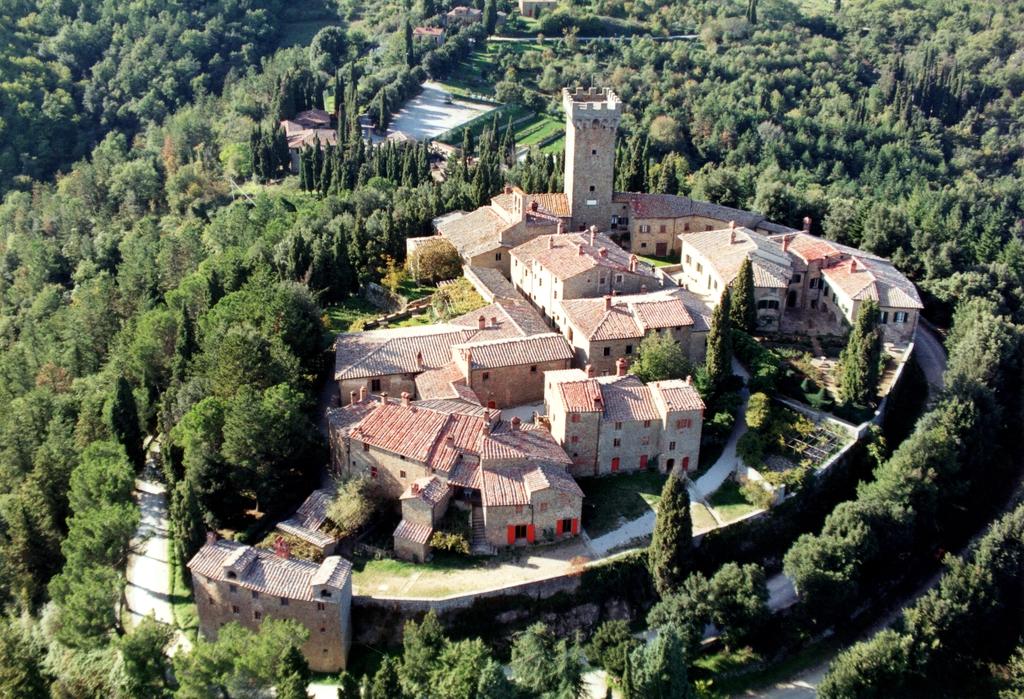
Francesco Borromini said that boundaries are folded around the space and are developed in curves and folds. His work on the San Carlo in Sapienza depicts that walls are capable of being flexible and malleable. The skin of the structure becomes a part of the space instead of being just a face. There are 4 fountains(Quatro Fontane) that are built on the exterior of the structure. One of them is built within the wall, almost making it seem like an extension of it, in the form of a porch.
For making the model of the chambers we used the same idea of expressing the emotions we chose earlier.
MODEL 1
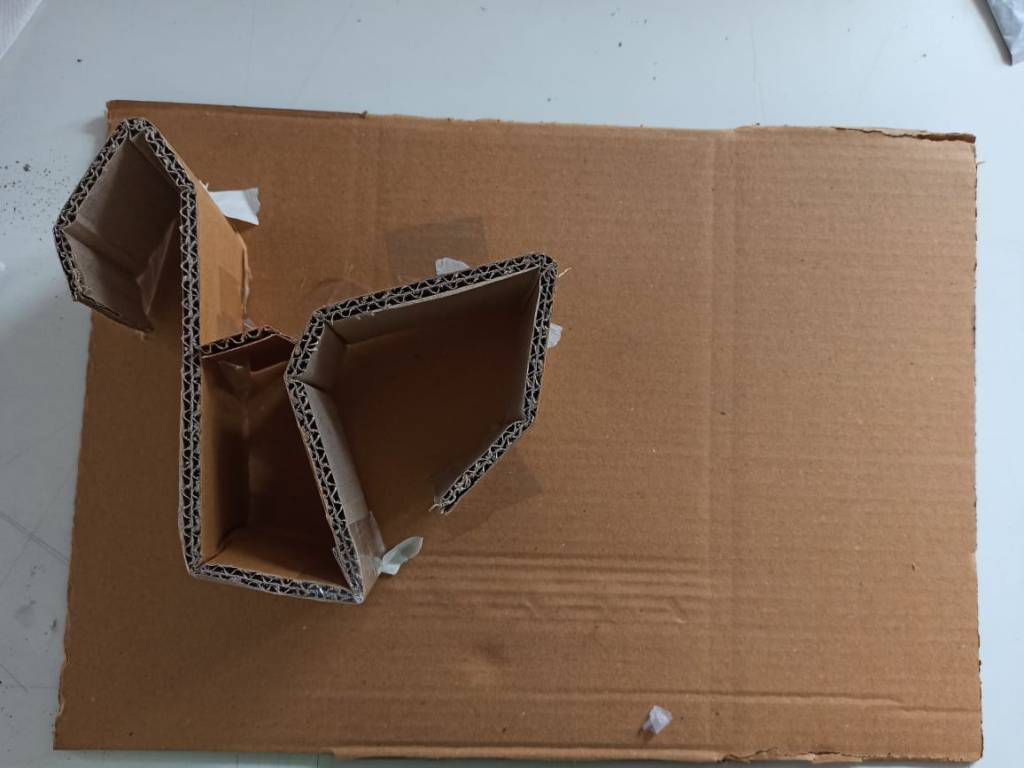
The prop that was provided was cardboard. We cut out a piece of 4×1 and manoeuvred it to make chambers in the form of an architectural “plan” . The visual representation of “anxiety” reminds of places that are dark and secluded. These spaces induce anxiety when I’m left alone in it with my thoughts and nothing else. Overthinking, for me, causes anxiety. To represent it, I folded the board 10 times, forming 3 closed zones where light could not enter easily. These spaces have triangular corners. These rooms that are thus formed are eerily small, enclosed, and dark. The model is being looked at from the top and in the form of a plan with it’s horizontal cross-section making the spaces look like a room. Therefore, anxiety is induced ‘in plan’. However, if one were to look at it from any other angle, say the front side, it wouldn’t make much sense.
MODEL 2


This time, I made a sectional view of the model where the viewer would look at it from the front. It was slightly more difficult to represent this one. One of my professors told me – “ when in doubt, exaggerate!”. So I went ahead with that. I exaggerated the meaning of the term ‘anxiety’ and thought of including movement in it. I made a folded place which could be walked in from both sides and had asymmetric corners. There is a small opening at the back which the mini-me would not be able to get through and would induce anxiety. The curves and folds of the frontal section traps light in weird spaces. The mini-me would want to climb up the fold but wouldn’t be able to and that would cause frustration.
MODEL 3

The third model is a combination of a plan and section. So, the viewer could look at it from any side and angle and it should make sense. To do so, I made a base similar to the model of the plan and combined it with the curves of the section to create some dimension in the roof. The shade is asymmetric and looks absurd as there is no defined start and endpoints to it. This triggers one’s OCD. And it also blocks light from entering. Thus, for me it causes anxiety a lot more than the other two models. My mini-V would also be able to access this structure.


In conclusion I’d like to say that chambers, in all its forms, are a versatile way to build spaces.
 Varnika's thoughts
hi varnika!
this was a great blog!
one thing that id like to ask is that does your OCD cause anxiety for you? also since the openings and spaces are narrow, is your model really mostly accomodative for everyone to wander through?
otherwise, anxiety seems like an interesting and a fun emotion to work with because this is making you think wacky and thats interesting to look at and for you to think about 🙂
love,
akshita
LikeLike